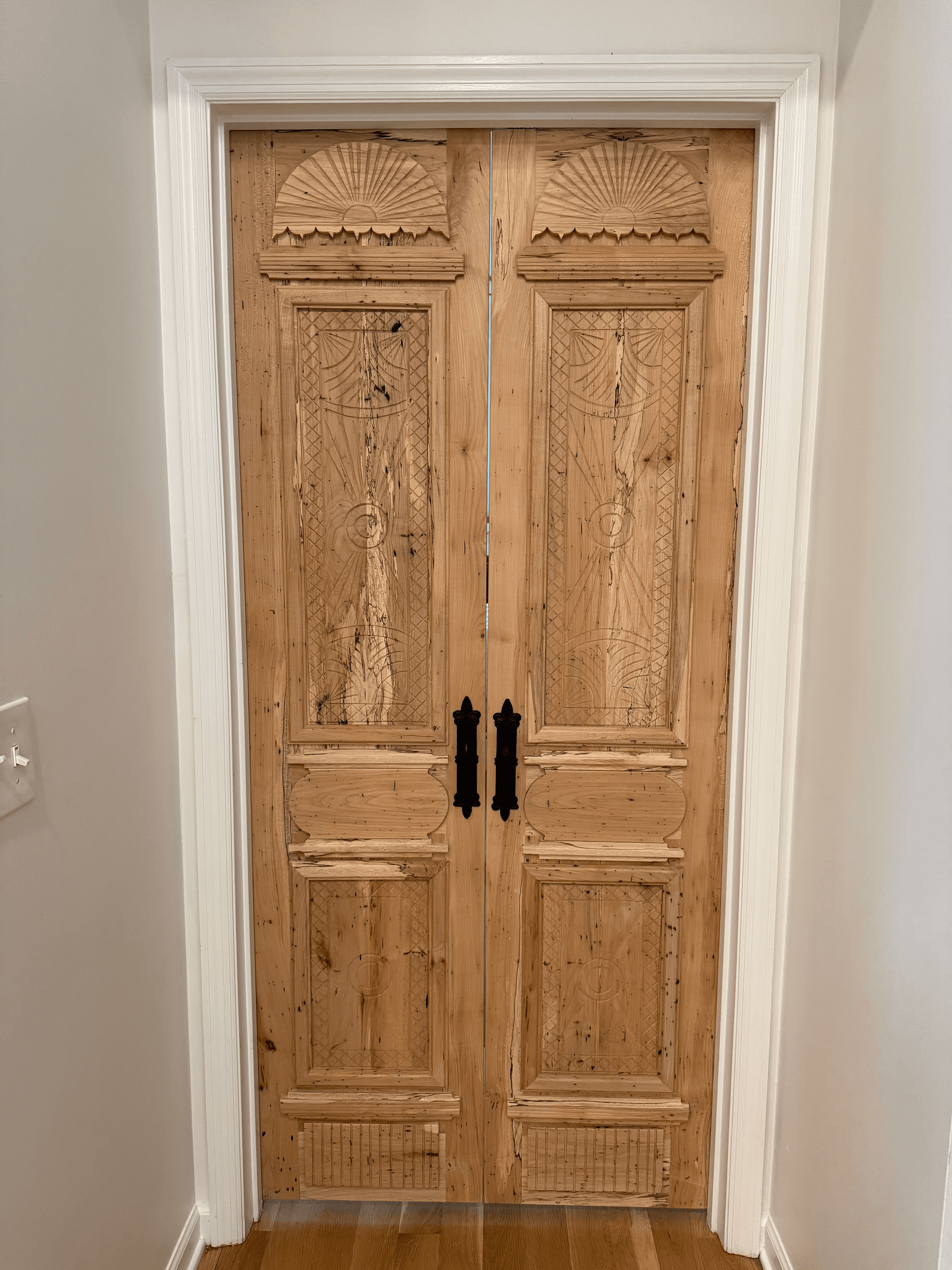
Hand Carved Colonial French Doors
MAPLE
$4,200
INQUIREThis statement piece features a pair of antique-style double doors milled from richly figured spalted maple, characterized by sweeping mineral streaks and organic worm-holes unique to each board. Each panel is hand-carved with sunburst fans, lattice crosshatch, and flowing ribbon motifs — a mirror image across both doors that honors centuries of European craftsmanship.
Specifications
Tree Origin
Every piece in this collection is milled from trees salvaged on the Legg Farm in North Columbia — wood that would have otherwise been lost to the fire. Locally sourced and thoughtfully turned into lumber, each slab carries the living history of a single piece of land.
Tree History
The Seedling
On the Legg Farm in the fields of North Columbia, a maple seed fell and held. Through Tennessee's warm summers and hard winters, it pushed roots into the middle Tennessee soil and climbed toward the canopy — slowly, the way maples do, adding little more than a quarter inch of diameter each year.
Six Decades on the Farm
For more than sixty years this maple grew through Tennessee summers and ice storms, adding a slow ring each year. By the time the Legg family acquired the land in 2005, the tree was already middle-aged — already part of the farm's character. It kept growing, until its trunk pushed past twenty inches across and its canopy spread wide over the hillside.
Disease and Decay
Disease moves quietly through maple. What begins as a subtle dieback — a branch here, a patch of bark there — spreads inward over seasons. As the tree began losing limbs, it became a hazard rather than an asset. The decision was made to take it down before it came down on its own.
The Mill
The tree was felled and brought to the mill before rot could claim what disease had started. Using through and through milling — cutting the trunk in full parallel slabs from one end to the other — nothing was wasted and nothing was hidden. The spalting that had already begun working through the wood wasn't a flaw to cut around. It was kept, every dark line and mineral streak preserved as a record of the tree's final years on the farm.